Health & Economic Geographies
Workforce Patterns and Income Disparities in a Growing US City
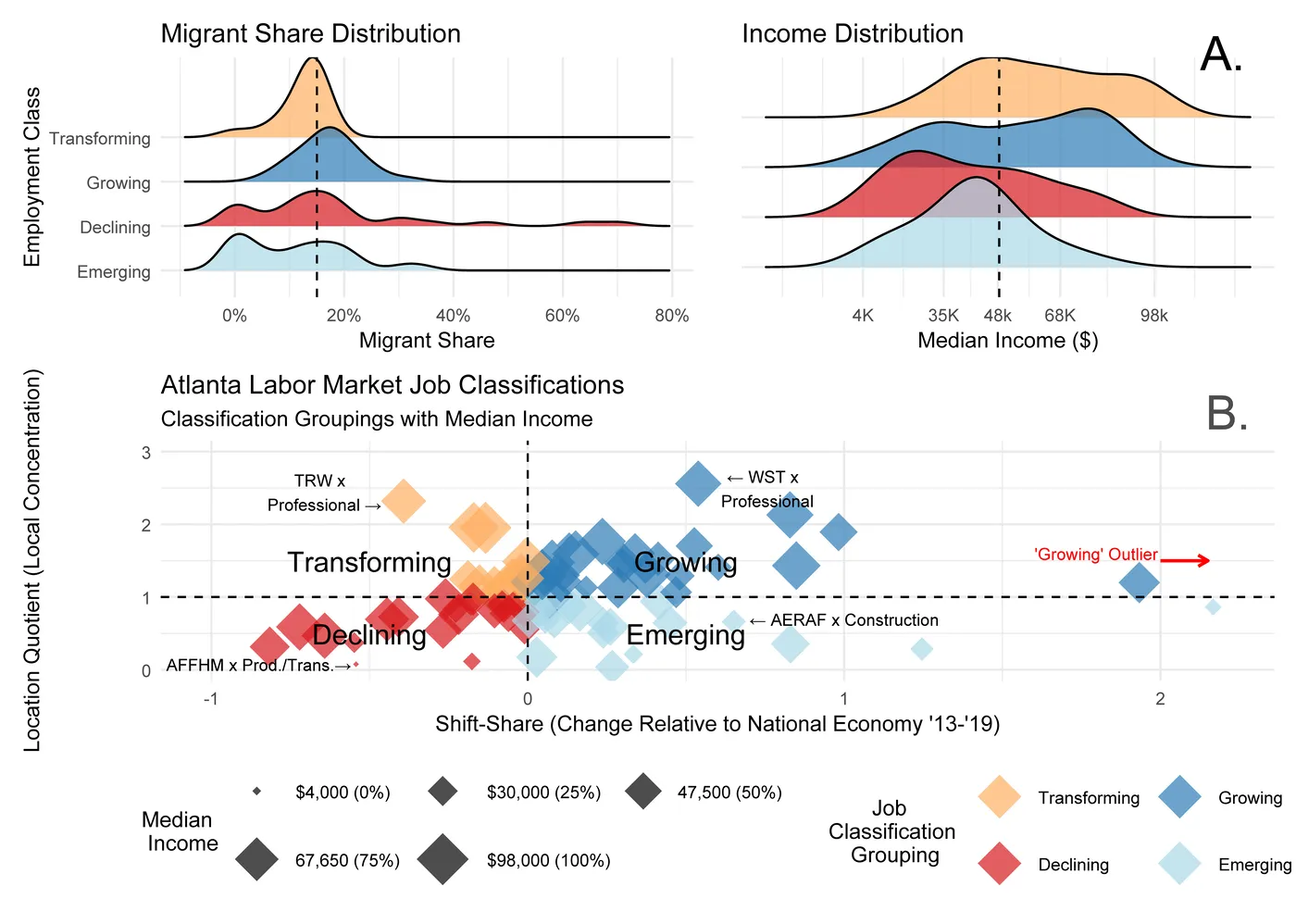
99 Job Types
Industry-occupation combinations classified into four sectors
438K
Domestic Migrants into Atlanta 2013–2019
$54K
Median income gap between Declining and Growing sectors
~30%
Income penalty faced by Black workers in higher-paying Growing jobs vs. White workers
Summary
How does where you work shape your income, and does that relationship hold equally across race, ethnicity, and migration status?
With Anthony Howell and Sharmistha Bagchi-Sen, I built a four-sector job classification taxonomy applied to 99 industry-occupation combinations drawn from US Census PUMS microdata for 2013 and 2019, covering 33 Public Use Microdata Areas across the Atlanta metropolitan area. We classified each job designation using two indicators: shift-share analysis, which measures how a job grew relative to the national economy, and location quotients, which measure how concentrated that job is locally versus nationally. Combining these two dimensions produces four sectors: Declining (shrinking locally and nationally), Emerging (growing locally but underspecialized), Growing (expanding with strong local concentration), and Transforming (locally specialized but declining nationally). This framework moves beyond traditional dual-sector ("good job / bad job") approaches to capture the intermediate and transitional labor markets that define contemporary urban economies.
The results reveal sharp racial and ethnic stratification across Atlanta's 2.8 million workers. Black and Hispanic workers are disproportionately concentrated in Declining and Emerging sectors, while White and Asian workers predominantly occupy higher-paying Growing and Transforming sectors. Median incomes reflect this divide starkly: Growing sector workers earn $75,611 on average versus $36,486 in Declining. Within the Growing sector alone, White workers earn over $102,000 compared to $48,659 for Black workers.
Survey-weighted regression models controlling for education, English proficiency, gender, age, and industry fixed effects uncover a reversal: Black workers out-earn White workers by 14.5% in lower-paying Emerging jobs, but face income penalties of nearly 30% in higher-paying Growing jobs. Multinomial logit models further show that skilled Black domestic migrants are channeled into lower-paying sectors not due to a lack of qualifications, but because of structural barriers restricting access to higher-quality employment. In a rapidly growing Sunbelt city shaped largely by domestic migration, these findings show how historically entrenched inequalities persist through the structure of the labor market itself.
Citation
Workforce patterns and income disparities in a growing US city
Berg, A. K, Howell, A., & Bagchi-Sen, S. — DOI: 10.1093/jeg/lbaf071